
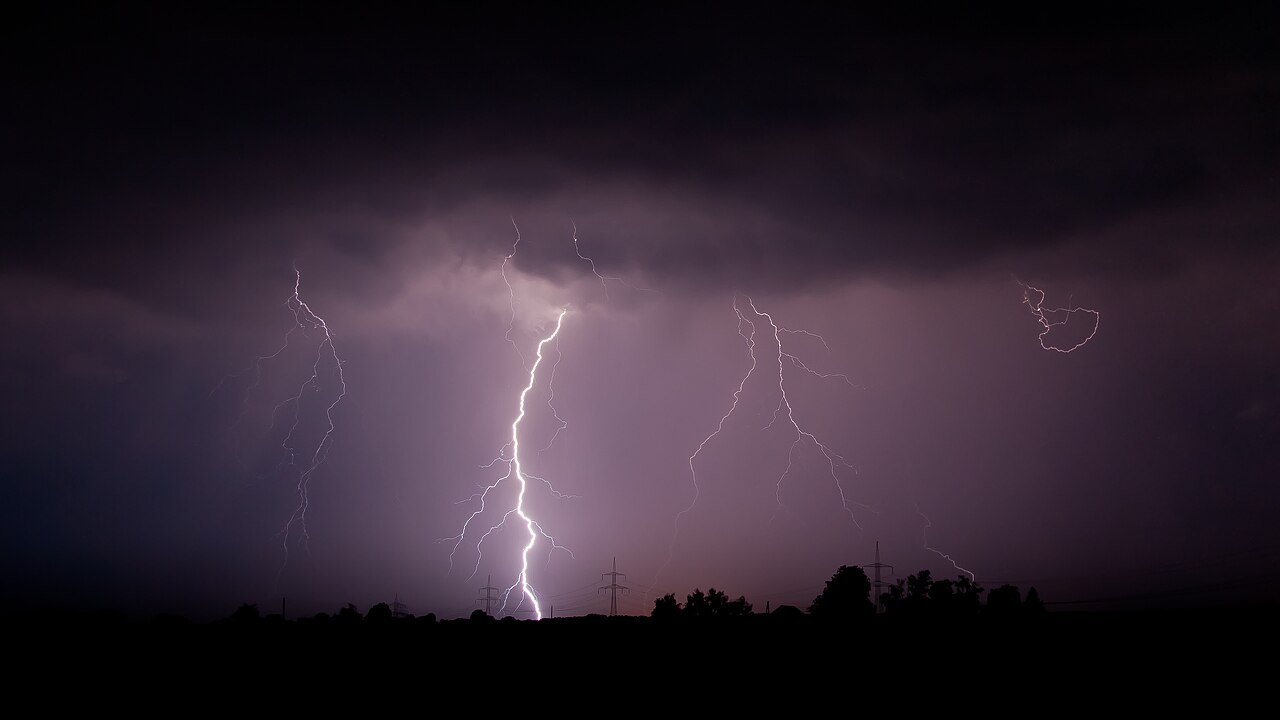
What Causes Heavy Rain?
Heavy rain happens when a lot of moist air is lifted quickly and cools below the dew point. Convection, orographic uplift and low-pressure systems each cause a different rain signature.
A good grasp of weather physics also helps you make sharper daily decisions — whether to sit outside, whether that dark cloud actually means rain, whether the airline delay is genuinely weather-related, and how to protect yourself in a thunderstorm. The same physics also explains climate change and why India is seeing more heavy-rain events year after year.
This guide covers the core weather ingredients (temperature, humidity, pressure, wind, cloud, rain), the key concepts every reader should know (rain probability, feels-like, AQI, UV), how the same atmosphere produces different weather in different cities and where to keep learning about the atmosphere for free.
🌦 The Core Weather Ingredients
Every weather event is a combination of six variables: temperature, humidity, air pressure, wind, cloud cover and precipitation. Instruments measure each: thermometer (temperature), hygrometer (humidity), barometer (pressure), anemometer (wind), ceilometer (cloud height), rain gauge (rainfall).
The atmosphere is a massive engine that constantly moves heat from the equator toward the poles. Every storm, monsoon, cyclone and heat-wave is a symptom of this engine at work. Air rises where it is heated at the equator, moves toward the poles at height, sinks in the sub-tropics as high-pressure systems and returns near the surface as the trade winds and westerlies.
In India, the seasonal wind reversal drives the Southwest Monsoon (June–September) and the Northeast Monsoon (October–December). Both are the same engine flipping direction with the sun’s overhead position and the differential heating of land versus ocean.
📅 Weather Concepts You Should Know
| Concept | What It Measures | Everyday Impact | Where to Check |
|---|---|---|---|
| Temperature | Air heat content in °C | Clothing, health, crops | IMD, Google Weather |
| Rainfall (mm) | Depth of rainfall | Roads, farms, floods | IMD Mausam, Windy |
| Humidity (%) | Water vapour in air | ‘Feels like’ warmth | AccuWeather, IMD |
| Wind Speed (kmph) | Air movement | Flight, cyclone, hoardings | Windy, AccuWeather |
| UV Index | Sun exposure risk | Sunburn, skin health | Google Weather |
| AQI | Pollution level | Breathing, health | CPCB SAMEER, IQAir |
| Probability of Precipitation | % chance of rain | Umbrella decision | IMD, Google |
🏙 Why Different Cities Get Different Weather
A city’s weather is decided by latitude, altitude, proximity to sea, mountain shadow, urban heat island and the prevailing wind. Mumbai is warm and humid because it sits on the Arabian Sea; Delhi is dry and continental because it sits 1000 km inland; Shimla is cool because it sits at 2200 m; Cherrapunji is the wettest because moist air is lifted straight up against the Khasi hills.
The same monsoon system deposits 3000 mm of rain on Kerala’s coast and 400 mm on interior Karnataka just 300 km apart, because the Western Ghats squeeze the moisture out on the western slope and leave a rain-shadow on the east. Understanding this simple physics helps you read any Indian city’s forecast in five seconds.
🛡 Weather Safety Tips Everyone Should Know
- Read the forecast card end-to-end — temperature is not the only useful number.
- Cross-check any single app against IMD before making an important decision.
- Learn the difference between weather and climate — don’t confuse a hot week with climate change on its own.
- During a thunderstorm, avoid tall trees, open fields and metal fences — indoors is safest.
- Bookmark your city page on the IMD Mausam app to save time every morning.
- Teach children the basics of pressure, humidity and clouds — it stays with them for life.
📱 Where to Learn More About Weather
IMD’s website has an excellent public-education section on monsoon, cyclone and heat-wave. NOAA and the UK Met Office publish free explainer videos and interactive weather-education portals. The Weather Channel YouTube channel breaks down storms in plain English.
Windy.com is a beautiful interactive weather globe that helps you see the physics visually — pan across the world and toggle between temperature, wind, humidity, precipitation and pressure layers. For students, the National Council of Educational Research and Training (NCERT) geography textbook chapters on climate remain the clearest single-page introduction to Indian weather patterns.
❓ Frequently Asked Questions
What is the difference between a watch and a warning? A ‘watch’ means conditions are favourable for the hazard (heat wave, cyclone) — be aware. A ‘warning’ means the hazard is imminent or already occurring — take action.
How far out can a forecast be trusted? Day-1 and Day-2 forecasts are 85–90% accurate. Accuracy tapers to about 60% by Day-7 and 50% by Day-10. Beyond 10 days, a forecast is a broad guide only.
Is climate change making Indian weather more extreme? Long-term data shows more frequent heavy rain events, longer heatwaves and shorter but more intense monsoon rain bursts across India, consistent with global climate-change trends.
What is a cyclone? A cyclone is a low-pressure system with rotating winds — in the Indian Ocean, cyclones form over warm sea surface temperatures (26°C+) and rotate anti-clockwise in the northern hemisphere and clockwise in the south.
What is the Coriolis effect? The apparent deflection of moving air due to Earth’s rotation — deflects to the right in the northern hemisphere and to the left in the south. It’s why cyclones spin the way they do.
🔎 A Short History of Weather Forecasting
Weather forecasting as a science started in the 1850s when the electric telegraph made it possible to share barometer readings across cities in near-real-time. Robert FitzRoy of the UK Met Office issued the first daily weather forecasts in newspapers in 1861.
In the 20th century, radar (1940s), satellites (1960s) and supercomputers (1970s–present) transformed forecasting. Today, ECMWF and NOAA GFS run millions of atmospheric equations every six hours to project the next 10–14 days of global weather with steadily improving accuracy.
🏙 Indian Cities to Check
Bookmark this page and check the live forecast every morning.
Plan the day around real data — dress right, protect family, protect crops and stay safe.
