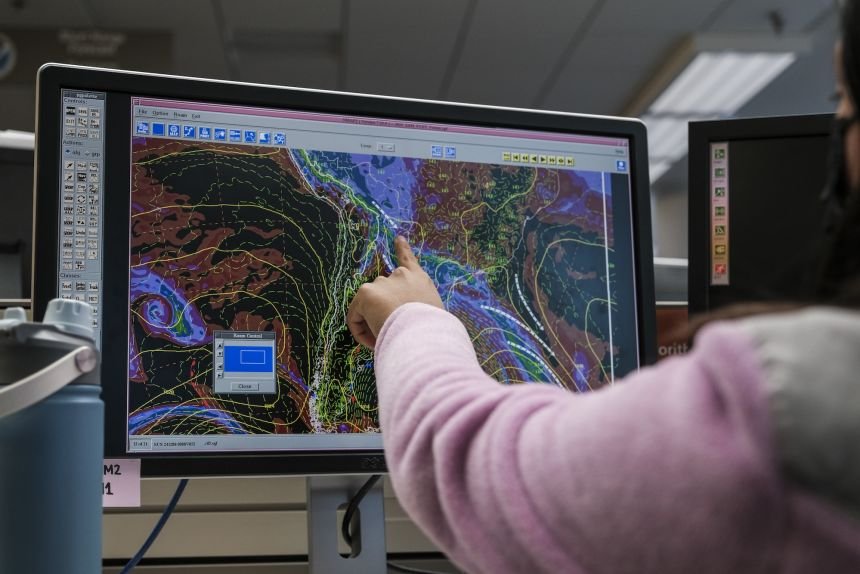
Knowing how to check the weather forecast accurately can make everyday planning much easier. Whether we are preparing for a trip, commuting to work, planning an outdoor event, managing agricultural activities, or simply deciding what to wear, accurate weather information helps us make better decisions.
Modern weather forecasting combines satellite observations, weather stations, radar systems, computer models, and meteorological expertise. However, not every weather app or forecast should be interpreted in exactly the same way. Understanding temperature forecasts, rain probability, hourly predictions, weather alerts, radar images, wind information, and forecast reliability can help us determine what the weather is actually likely to do.
This complete guide explains how to check the weather forecast accurately and how to interpret the information before making daily plans.
Why Accurate Weather Forecasts Matter
Weather affects almost every part of daily life. A sudden thunderstorm can disrupt travel, heavy rainfall can cause waterlogging, and extreme temperatures can affect outdoor activities and health.
By checking a reliable forecast before leaving home, we can prepare for changing conditions instead of reacting to them.
An accurate weather check is particularly useful for:
- Daily commuting
- Road trips and air travel
- Outdoor events
- Hiking and camping
- Farming and irrigation
- Construction work
- Sports activities
- School and college activities
- Photography and tourism
- Business operations
- Marine and coastal activities
The most useful approach is not simply asking, “Will it rain?” Instead, we should examine when rain is expected, how likely it is, how intense it may become, and whether an official warning has been issued.
Use Reliable Weather Sources
The first step toward getting an accurate weather forecast is choosing a trustworthy source.
In India, the India Meteorological Department (IMD) is an important official source for weather observations, forecasts, warnings, radar information, and other meteorological services.
For important decisions, we should prioritize official meteorological agencies over an unknown website or social-media post.
Weather information can also be obtained through reputable weather applications and services. However, different services may use different forecasting models, update schedules, and data-processing methods. Small differences between forecasts are therefore normal.
Check the Forecast for Your Exact Location
One of the most common mistakes is checking the weather for an entire city or region and assuming the conditions will be identical everywhere.
Weather can vary significantly within relatively short distances, particularly during thunderstorms and heavy rainfall.
For example, one neighborhood may receive a strong shower while another part of the same city experiences only cloudy conditions.
Whenever possible, we should check the forecast for:
- Our exact city
- Neighborhood or locality
- District
- Travel destination
- Airport or railway station
- Mountain or coastal location
- Outdoor activity location
The more specific the location, the more useful the forecast can be for practical planning.
Check the Hourly Weather Forecast
A daily forecast can tell us whether rain is expected, but an hourly weather forecast can provide much more useful information.
Suppose the forecast says there is a chance of rain today. That does not necessarily mean rain will continue all day.
An hourly forecast may show that rain is most likely during the afternoon while the morning and evening remain comparatively dry.
Before planning an outdoor activity, we should check:
- Hourly temperature
- Hourly precipitation probability
- Expected rainfall
- Cloud cover
- Wind speed
- Thunderstorm potential
This allows us to choose a better time for travel or outdoor activities.
Understand Rain Probability
The probability of precipitation is one of the most misunderstood weather forecast measurements.
A precipitation probability does not automatically mean that the specified percentage of the day will experience rain. Its precise interpretation depends on the forecasting system and context.
For practical purposes, we should treat precipitation probability as an indication of how likely measurable precipitation is under the forecast conditions.
It is also important to consider the expected rainfall amount. A forecast indicating a possibility of rain could represent anything from a brief shower to a more significant rainfall event.
Therefore, we should look at rain probability and expected precipitation together.
Check Rainfall Intensity
Knowing that rain is expected is not enough. We should also determine whether the forecast indicates:
- Light rain
- Moderate rain
- Heavy rain
- Very heavy rainfall
- Thunderstorms
- Persistent rainfall
- Isolated showers
A short light shower may have little impact on travel, whereas intense rainfall can cause reduced visibility, traffic congestion, waterlogging, and dangerous road conditions.
When an official weather agency issues a heavy-rainfall warning, that information should receive more attention than a simple daily weather icon.
Look at Weather Radar
Weather radar is particularly useful when we want to understand what is happening right now and how precipitation systems are moving.
Radar imagery can show areas of precipitation and help us observe whether a rain system is approaching, moving away, or developing nearby.
For short-term decisions, radar can sometimes be more useful than looking only at a forecast made many hours earlier.
Radar is especially helpful when:
- Dark clouds are approaching
- Rain is expected soon
- A thunderstorm is developing
- We are planning a short outdoor activity
- We are traveling during unstable weather
- Heavy rainfall is already occurring nearby
However, radar images should be interpreted carefully. They show observed or estimated precipitation patterns and do not guarantee exactly what will happen at a particular street or location.
Check Thunderstorm and Lightning Warnings
Rainfall is not the only weather hazard we should monitor.
Thunderstorms can bring lightning, strong winds, heavy rain, and sudden changes in conditions.
A forecast that simply displays a rain icon may not communicate the full level of risk. Therefore, when thunderstorms are possible, we should check official alerts and warnings.
This is particularly important for:
- Outdoor workers
- Construction workers
- Farmers
- Hikers
- Campers
- Sports participants
- Travelers
- People attending outdoor events
If an official warning indicates dangerous weather, safety information should take priority over normal activity plans.
Check Wind Speed and Direction
Wind is another important part of an accurate weather forecast.
Strong winds can affect driving, aviation, boating, construction, outdoor events, and recreational activities.
When checking the forecast, we should look at:
Wind speed: Indicates how fast the air is moving.
Wind direction: Shows where the wind is coming from.
Wind gusts: Indicate short periods when wind may become significantly stronger than the average wind speed.
Gusts can be particularly important because average wind speed alone may not reveal the strongest conditions expected.
Check Humidity and Feels-Like Temperature
The temperature shown on a weather app is not always the same as how the air feels.
Humidity can influence how warm conditions feel, particularly during hot weather. High humidity can make warm temperatures feel more uncomfortable.
Similarly, wind can make cool weather feel colder.
That is why some weather services provide a feels-like temperature or apparent temperature.
When planning outdoor activities, checking both the actual temperature and apparent temperature can provide a better understanding of expected conditions.
Check the Weather Forecast Multiple Times
Weather forecasts are updated as new observations and model information become available.
For ordinary daily planning, checking the forecast once may be sufficient. However, for important travel or outdoor activities, checking it again closer to the event can be useful.
A practical approach is:
Several days before: Check the broad weather pattern.
One day before: Examine the updated hourly forecast and precipitation outlook.
A few hours before: Check current conditions, radar, and official warnings.
Immediately before departure: Confirm whether any new weather alerts have been issued.
This approach is especially useful during rapidly changing weather conditions.
Do Not Rely on a Single Weather App
Different forecasting services may provide slightly different predictions.
This does not necessarily mean one of them is wrong. Weather prediction involves uncertainty, and different services may process meteorological data differently.
For routine activities, one reliable source may be enough. For important plans, we can compare information from a reputable weather service with the official meteorological agency.
If multiple sources agree on the general conditions, confidence in the overall forecast can be higher.
If they disagree substantially, we should recognize the uncertainty and plan accordingly.
Understand Short-Term and Long-Term Forecasts
Forecast accuracy generally depends partly on how far into the future we are looking.
A forecast for the next few hours is typically more useful for immediate decisions than a forecast for a much later date.
We can divide forecasting into practical categories:
Nowcasting
Nowcasting focuses on current conditions and the very near future. Radar, satellite observations, and real-time weather measurements can be particularly useful.
Short-Term Forecast
This generally covers the next few days and is useful for everyday planning.
Extended Forecast
Longer-range forecasts can help identify broad weather patterns, but they should be treated with greater uncertainty.
For important plans, we should avoid treating a long-range forecast as a guaranteed prediction.
How to Check Weather Before Traveling
Before a road trip, flight, train journey, or other travel, we should check both the departure location and destination.
For road travel, it can also be useful to examine the weather along the route.
We should look for:
- Heavy rainfall
- Thunderstorms
- Strong winds
- Visibility problems
- Flooding risks
- Extreme temperatures
- Mountain weather
- Coastal weather
- Official travel or weather warnings
Weather conditions can change considerably during a long journey, so checking only the starting location may not be sufficient.
How to Check Weather Before an Outdoor Event
Outdoor events require more than a simple temperature check.
We should examine the forecast for the entire event period and pay special attention to precipitation, thunderstorms, wind, and extreme temperatures.
For large events, organizers should monitor official warnings and have contingency plans for severe weather.
An event scheduled for the afternoon may need a different plan if thunderstorms are expected during those specific hours.
How Farmers Can Use Weather Forecasts
Weather forecasts are particularly valuable for agriculture.
Farmers can use forecasts to make decisions related to:
- Irrigation
- Planting
- Harvesting
- Fertilizer application
- Crop protection
- Pest management
- Livestock care
- Equipment operations
Rainfall forecasts should be considered alongside soil conditions, crop requirements, and local agricultural recommendations.
Common Weather Forecast Mistakes
Several mistakes can lead to poor weather-related decisions.
Checking only the temperature
Temperature alone does not tell us whether it will rain, become windy, or experience thunderstorms.
Ignoring hourly information
A daily rain prediction does not mean rain will occur throughout the entire day.
Ignoring official warnings
Severe weather alerts deserve greater attention than ordinary forecast icons.
Checking an outdated forecast
Conditions can change, so older information may no longer reflect the latest forecast.
Assuming nearby locations have identical weather
Localized thunderstorms and rainfall can produce substantial differences between locations.
Confusing probability with certainty
A probability of precipitation represents uncertainty and should not automatically be interpreted as a guarantee.
A Simple Daily Weather-Checking Routine
We can create a simple routine that takes less than a few minutes.
Step 1: Check the current temperature.
Step 2: Look at today’s maximum and minimum temperatures.
Step 3: Check the hourly precipitation forecast.
Step 4: Look for thunderstorms, lightning, or heavy-rain warnings.
Step 5: Check wind speed and gusts.
Step 6: Check humidity and feels-like temperature.
Step 7: Review radar if rain is approaching.
Step 8: Check again before important outdoor activities.
This routine provides a much more complete picture than simply looking at a weather icon.
Final Thoughts
Learning how to check the weather forecast accurately is about understanding more than temperature. We should examine the location, hourly conditions, precipitation probability, rainfall intensity, wind, humidity, radar information, and official weather warnings.
For routine planning, a reliable local forecast can provide useful guidance. During severe or rapidly changing conditions, official meteorological warnings and real-time information become particularly important.
By checking updated forecasts and understanding what each weather measurement means, we can make better decisions about travel, work, outdoor activities, agriculture, and everyday life.
The most reliable approach is simple: check a trusted source, use the forecast for the exact location, examine hourly conditions, monitor official warnings, and update the forecast before important plans.